
Anatomical variability
What is anatomical variability of the hand?
The human hand differs from one person to another. Just as each individual has a unique appearance, the anatomical structures of the hand also vary in their size, shape, course, and relative position. Anatomical variability of the hand may involve all structures, from bones and ligaments to muscles, tendons, and even the superficial skin creases of the palm. Some structures may be duplicated, others may be completely absent, while additional structures may also occur. In itself, such variation does not necessarily imply any problem; however, in many situations it may influence the clinical examination, the interpretation of imaging studies, and the course of surgery.
Why is the anatomical variability of the hand important?
Knowledge of anatomical variations is not merely an academic curiosity. In hand and wrist surgery, it may determine both the safety of a procedure and the correct understanding of a patient’s symptoms. Variable structures may mimic pathological findings, alter the biomechanics of the hand and wrist, or increase the risk of iatrogenic injury to nerves and vessels. Some variants are important in tendon transfers, others in the surgical treatment of carpal tunnel syndrome or trigger finger, or in the interpretation of dorsal wrist pain. Moreover, many hypotheses regarding the significance of certain variants still require further experimental verification, and they should therefore be approached critically and in an evidence-based manner.
See our article on anatomické variabilitě při operačních přístupech ke zlomeninám distálního radia
Where can anatomical variations occur in the hand and wrist?
1. Superficial palmar creases
Three main palmar creases are commonly found in the palm. Their course, however, is variable, and the literature also describes specific arrangement patterns such as the simian, Sydney, or Suwon crease. These differences are of particular importance in genetics and morphology. In our work, we also clarify their relationship to deeper structures of the hand. However, the superficial creases alone cannot be relied upon unreservedly to predict the deep anatomy.
For more details, see our study: Kunc V et al., 2020. The superficial anatomical landmarks are not reliable for predicting the recurrent branch of the median nerve.
2. Hand muscles
Anatomical variability of the hand muscles probably contributes to the fact that each person has slightly different fine motor skills and a different ability to move individual fingers in isolation. Such variation involves, for example, the lumbrical muscles, the thenar and hypothenar muscles, and, more rarely, accessory muscles. Some accessory muscles may remain clinically silent, whereas others may produce a mass effect, pain, or contribute to compression of neural structures. In the lumbrical muscles, a more proximal origin may lead to their passage through the carpal tunnel, thereby increasing the risk of developing carpal tunnel syndrome.
For more details, see our study:
Kunc V et al., 2019. Accessory flexor carpi ulnaris muscle with associated anterior interosseous artery variation: case report with the definition of a new type and review of concomitant variants
Belbl M et al., 2023. Variations of the lumbrical muscles of the hand: Systematic review and meta-analysis.
3. Tendon sheaths and pulleys
Variability of the tendon sheaths and pulleys is particularly important from a biomechanical and surgical perspective. The pulleys keep the flexor tendons close to the skeleton and prevent bowstringing. Their different arrangement may affect finger function as well as the outcome of surgical treatment. In both the thumb and the fingers, there are variants in the number, length, and interconnections of individual pulleys. This is relevant, for example, in the treatment of trigger thumb or trigger finger, where the pathological constricting structure must be released while preserving the stabilizing system as much as possible. In addition, variability of the tendon sheaths is important in the spread of infection, which may at first appear in unexpected locations.
4. Nerves of the hand
Among the neural structures, variability of the median nerve and especially of its motor branch to the thenar, the so-called recurrent branch, is of particular importance. Its variable course is clinically crucial in carpal tunnel surgery, because injury to this branch may significantly impair thumb function and fine hand manipulation. Variability of the nerves of the hand is therefore one of the reasons why even an apparently routine procedure in the carpal region must be performed with detailed knowledge of the local anatomy.
5. Carpal skeleton
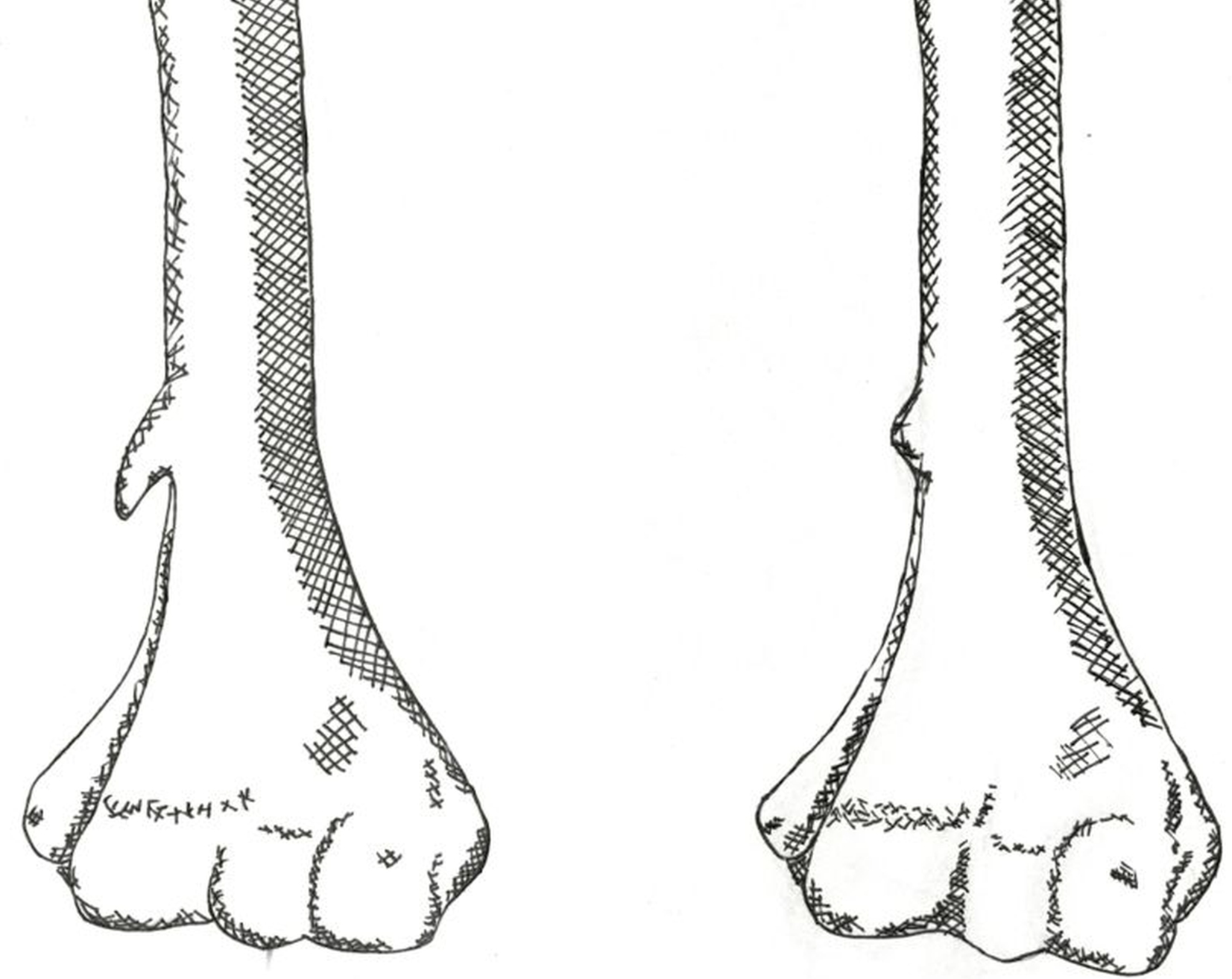
The bony structures of the wrist also demonstrate considerable variability. Differences may involve the distal radius and ulna, the shape of the articular surfaces, the arrangement of the carpal bones, congenital synostoses, and accessory ossicles. Particular attention has been paid to the lunate, which is traditionally divided into two basic types. Type II additionally has an articular facet for the hamate and has been associated in some studies with a higher frequency of chondral defects. In combination with ulnar plus variance , this type may also contribute to ulnar impaction syndrome. Variability of the wrist skeleton may therefore have a direct biomechanical as well as clinical impact.
See also our work on os trapezium bipartitum
When should anatomical variability be considered?
Anatomical variability of the hand should always be considered when:
- the clinical findings do not fully correspond to the usual presentation of the condition
- imaging reveals an unusual structure,
- a procedure is planned in an anatomically high-risk area.
Not every difference is pathological. And not every variant is insignificant. Precisely distinguishing between an anatomical variation and a true pathological condition is essential in hand surgery.
The hand and wrist belong to the most anatomically variable and, at the same time, the most functionally delicate regions of the human body. Anatomical differences may involve the superficial creases, muscles, tendon sheaths, pulleys, nerves, and the skeleton. Some remain asymptomatic throughout life, whereas others may affect biomechanics, complicate diagnosis, or alter the course of surgery. For this reason, anatomical variability of the hand is an integral part of modern hand and wrist surgery.